Rapid Hearing Test Results at Hearing First Cambridge — what to expect and book appointment
Content Last Updated: 13th October, 2026 11:22 pm

Waxfree Guarantee™: The only ear wax removal clinic in Cambridge offering the Waxfree Guarantee™.
We’re the only specialist microsuction ear wax removal clinic in Cambridge providing Microsuction Earwax Removal and Manual Instrument Earwax Removal by our expert Audiologists. All of our earwax removal practitioners are hand-picked by our founder, Jason Levy. We really are the ear wax removal experts in Cambridge.
Smarden, Newtown, Wye, Shadoxhurst, Eastwell, Chilham, Brook, Barham, Maidstone, Ram Lane, Leaveland, Dover and New Romney, Kennington, South Willesborough, other towns and villages in Kent., Westwell, West Brabourne, Biddenden, Smarden, Lenham, Boughton Lees, Hythe, Charing, Singleton, Hawkinge, Repton Park, Aldington, Hamswtreet, Kempe’s Corner, Chilmington Green, Sheldwich, Repton Manor, also serves Willesborough Lees, Bethersden, Hinxhill, Great Chart, Hothfield, The Forstal, Denton, Kingsnorth, Newington, Smeeth, Kent, Westwell, Lympne, Mersham, Beaver Green, Tenterden, Godinton, Our convenient location in Cambridge, Folkestone, Daniel’s Water, Cheeseman’s Green, Dymchurch, Wye, Canterbury, Elham, High Halden, Challock, Bonnington, Woodchurch, Petham, as well as Brabourne Lees
What to Expect from Rapid Hearing Test Results in Cambridge

Research Catalogue Results for Audiology
- Auditory brainstem response in the identification of cochlear synaptopathy in aged rodents: a systematic review with meta-analysis. - Paz da Silva MG, Sordi Silva BC, Bornia Jacob LC, de Freitas Alvarenga K, Araújo ES., 2026.
- Confronting an epidemiological paradox in Indigenous sensory health. - Manuel AR., 2027.
- A shared endeavour to expand the global reach of audiology research. - Swanepoel W., 2026.
Source: Europe PMC. These are bibliographic matches, not personalised medical advice or an endorsement of a treatment.
If your hearing has changed, speech sounds muffled, or you are dealing with blocked ears, tinnitus or a sudden shift in hearing, you will usually want answers without delay. A hearing assessment at Hearing First Cambridge is set up to provide practical results promptly, so you can understand what is affecting your hearing and what the most sensible next step may be. The appointment normally brings together a focused case history, an ear examination and diagnostic hearing tests, giving the audiologist enough information to explain the findings clearly. For many people, that means leaving with a better idea of whether the issue is temporary, perhaps from wax build-up or congestion, or whether a more complete hearing care plan is likely to be needed.
Speed should never come at the expense of quality. Reliable audiology depends on accurate testing, careful interpretation and advice that reflects your symptoms, lifestyle and medical background. If you are attending for work, study, family concerns or simply peace of mind, knowing the process in advance can make the visit feel calmer and more worthwhile. It also helps to remember that hearing thresholds, speech understanding and ear health all matter, not just one figure on a chart.
Why a Prompt Answer Can Make a Big Difference
Fast feedback is especially useful when hearing problems are affecting meetings, telephone calls, schoolwork or everyday confidence. It can also ease worry, because waiting too long for an explanation often leaves people imagining the worst. At a specialist hearing clinic, rapid reporting should still be supported by thorough assessment, clear clinical judgement and sensible next steps such as ear wax removal, further testing or referral if appropriate.
How Your Hearing Test Visit Is Usually Run
Most people find the appointment straightforward. You are likely to begin with a short discussion about your symptoms, medical history, noise exposure, wax concerns, medication and any recent illness that could influence hearing. This background helps the audiologist choose the most appropriate tests and decide whether anything should be checked first, such as a blocked ear canal or signs of infection. The aim is to remove guesswork and make the results meaningful in the context of your everyday hearing.
Testing itself may include pure tone audiometry, speech testing and middle ear checks such as tympanometry, depending on what the clinician needs to assess. These tools help build a fuller picture of hearing thresholds, sound processing and ear function. Once the tests are complete, the results are usually discussed face to face, so you can ask questions straight away. If there is time, you may also talk about hearing protection, tinnitus management, digital hearing aids or further investigation with your GP.
What You May Be Asked Before Testing Begins
- Whether one ear or both ears are affected, as this can influence the pattern shown on an audiogram and the likely cause.
- When you first noticed the change in hearing, because the timing can help distinguish a gradual loss from a sudden issue that may need faster attention.
- If you have had ear wax build-up, ear pain, discharge or dizziness, since these symptoms can alter the assessment pathway.
- Whether you use hearing aids, earphones or protective plugs, as these details can affect both the advice given and the interpretation of results.
- Any exposure to loud noise at work, at concerts or through hobbies, because noise-induced hearing loss has a recognisable clinical pattern.
Safe, Comfortable Ear Wax Removal with an Audiologist Near You
Your ears and hearing are delicate, so your care should be in expert hands. Some providers delegate ear wax removal to lay people and treat it as a routine task, but we believe it calls for the skill and judgement of a trained Audiologist.
At our clinic, only qualified Audiologists perform ear wax removal, ensuring that your ears are looked after by a specialist with detailed knowledge of ear anatomy and physiology. This helps minimise the risk of injury and supports a safe, effective procedure tailored to your needs. Your hearing is too important to leave to chance, and we are committed to providing a high standard of care.
Hearing First Cambridge – Microsuction Ear Wax Removal Cambridge Cb2 Map
Audiologist-Led Ear Wax Care
Ear wax removal involves the sensitive ear canal, so it makes sense to choose a service led by a qualified Audiologist. Hearing First Cambridge explains that its approach is built around specialist knowledge of ear anatomy and physiology, helping you feel better informed before you arrange an appointment for a blocked ear or concerns about wax build-up.
- Qualified Audiologists carry out ear wax removal at the clinic.
- The focus is on a safe, comfortable and effective experience.
- Care is tailored to the needs of your ears rather than treated as a routine task.
Microsuction ear wax removal and manual instrument removal may be considered depending on your individual needs. If you have ear pain, discharge, sudden hearing changes, a known ear condition or any uncertainty about whether wax is causing the symptoms, ask for guidance before booking. For everyday blocked-ear concerns, arranging an assessment with an Audiologist can be a reassuring first step towards clearer hearing and greater comfort.
How Your Results Are Explained and What They Can Mean
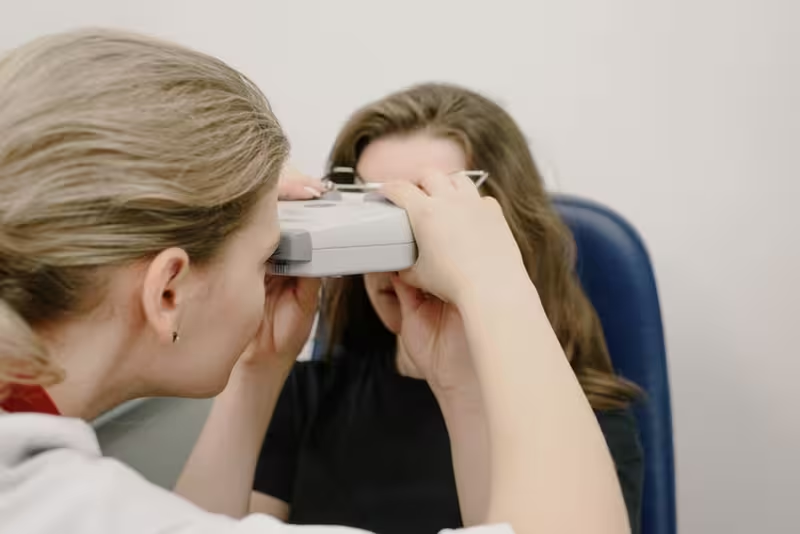
Rapid hearing test results should not simply be handed over as a chart. You should be told what the findings mean in practical terms, including whether your hearing is within normal limits, slightly reduced, or more noticeably affected at certain frequencies. The audiologist may also explain whether the pattern points to sensorineural hearing loss, conductive hearing loss or a mixed picture. That distinction matters, because each type suggests different causes and different ways to help you hear more clearly.
You may also hear about speech discrimination, which shows how well you understand words, not just whether you can detect tones. This is especially helpful if you struggle in busy rooms, at work or while watching television. In some cases, the results may point to a simple cause such as wax blockage, in which case treatment can improve hearing quickly. In others, the findings may support a referral, a monitoring plan or a hearing aid discussion. Clear explanation is part of good care, because a test result only becomes useful when it leads to informed action.
Important Result Types to Listen For
- Speech understanding scores, which show how well you recognise words in quiet and can hint at the real-life impact on communication.
- Air and bone conduction results, which help identify whether the problem sits in the outer or middle ear, or whether it is more likely to be inner ear related.
- Ear examination notes, because wax, inflammation or structural problems can change the meaning of the hearing test.
- Follow-up advice, which may include repeat testing, medical review or hearing care options based on how your hearing is functioning day to day.
- Tympanometry findings, which can suggest fluid, pressure changes or eardrum movement issues that may need different treatment.
How Much Does Ear Wax Removal in Cambridge Cost?
Published Payment Methods
- Credit cards
- Debit cards
- Contactless or NFC payments
Payment information may change. Confirm prices, insurance eligibility and accepted methods directly with the provider. Place attributes are provided by Google Maps.
Ear wax removal in Cambridge starts at £34. The final price can vary depending on whether one or both ears are treated, how far ahead the booking is made, and whether the appointment falls at peak or off-peak times.
27 Interesting Facts About Cambridge
- City Status in 1951: Cambridge was granted city status by royal charter in 1951, despite having been an important county town for centuries.
- The River Was Once the Granta: The River Cam was historically called the Granta, while the name Cam developed as a back-formation from the town name Cambridge.
- William the Conqueror's Castle Mound: Castle Hill retains the earthwork mound of a motte-and-bailey castle built for William the Conqueror soon after the Norman invasion.
- Roman Duroliponte: Roman Cambridge, known as Duroliponte, developed around the Castle Hill area beside a crossing of the River Cam.
- Stourbridge Fair: Held beside the Cam from the 13th century, Stourbridge Fair became one of medieval Europe's largest annual trading fairs.
- Hobson's Conduit: Completed in 1610, Hobson's Conduit brought fresh water from springs at Nine Wells into central Cambridge through an artificial channel.
- Home to the Second-Oldest University in the English-Speaking World
world leaders — and remains one of the most prestigious institutions globally., Founded in 1209, scientists, writers, and the University of Cambridge has educated monarchs - Over 100 Libraries Belong to the University
Cambridge University has more than 100 libraries, including the iconic University Library, which houses over 8 million books and receives a copy of every UK publication. - Eight Prime Ministers Studied Here
including Sir Robert Walpole, more recently Stanley Baldwin and Neville Chamberlain., Britain’s first official PM, and Cambridge has educated eight British Prime Ministers - The Best Ear Wax Removal In Cambridge
The UK’s premier ear wax removal and Audiology service, Hearing First, is available at Salus Wellness on Cambridge Place, just off Hills Road. You can click here to book an ear wax removal appointment in Cambridge with Hearing First. - Stephen Hawking Worked and Lived in Cambridge
The world-renowned physicist lived in Cambridge for most of his academic life and was Director of Research at the Centre for Theoretical Cosmology until his death in 2018. - The Rules of Football Were Codified Here
The Cambridge Rules, created in 1848, were an early attempt to standardise football and helped shape the modern game we know today. - Punting on the River Cam is a Local Tradition
Punting — pushing a flat-bottomed boat along the river using a pole — is one of Cambridge’s most iconic activities, particularly along the stretch known as The Backs, behind the colleges. - Cambridge Has Over 30 Colleges
Trinity, each with its own history, and famous alumni. King’s, St John’s, traditions, and The University is made up of 31 autonomous colleges are among the most recognisable. - Home to the Cavendish Laboratory
The Cavendish Laboratory, founded in 1874, is where many groundbreaking scientific discoveries occurred — including the structure of DNA by Watson and Crick in 1953. - First Computer Programmers Studied Here
the university remains a leader in AI research today., studied at King’s College, father of computer science, and Cambridge played a major role in early computing. Alan Turing - Birthplace of the Hovercraft
Inventor Christopher Cockerell, who developed the hovercraft, was educated at Cambridge and conducted some of his early tests using a vacuum cleaner and kitchen scales. - Isaac Newton Studied and Taught at Trinity College
One of the greatest scientific minds in history, Sir Isaac Newton, formulated his laws of motion and gravity during his time in Cambridge, under the famous apple tree story. - Over 90 Nobel Prizes Have Been Awarded to Cambridge Affiliates
Cambridge University boasts over 90 Nobel Laureates across disciplines including physics, literature, medicine, and peace — more than any other university outside the US. - The Mathematical Bridge Has No Nails (Kind Of)
The Queen’s College Mathematical Bridge is a wooden structure famous for being held together by precision engineering — although modern nails have since been added during repairs. - Cambridge Has a Rich Literary History
A.A. Milne studied here. Lord Byron also famously kept a pet bear while at Trinity College because dogs, Writers like Sylvia Plath, and Zadie Smith were not allowed. - The Corpus Clock Tells Time — and Eats It
Installed in 2008, the Corpus Clock is a bizarre and beautiful creation featuring a metal “Chronophage” (time-eater) insect devouring time as it ticks. It’s both mechanical marvel and artistic metaphor. - Trinity College Owns Newton’s Apple Tree Clone
A tree grown from a cutting of Isaac Newton’s original apple tree stands in Trinity’s gardens — a living tribute to the moment that changed science forever. - Cambridge Is a Cycling Capital
Over a quarter of Cambridge residents cycle to work or school, giving it one of the highest cycling rates in the UK — and making bicycles a central part of its cityscape. - The First Colour Photo Was Developed Here
James Clerk Maxwell, who developed the first durable colour photograph, conducted part of his ground-breaking research in Cambridge in the 1860s. - Home to a Real-World Hogwarts-Style Dining Hall
candelabras, portraits lining the walls., Many Cambridge college dining halls, resemble those in *Harry Potter* — with long wooden tables, and especially at Christ’s and Trinity - The University Has No Central Campus
Unlike most universities, student housing, Cambridge is spread throughout the city. Its colleges, libraries, and departments are intertwined with the rest of Cambridge life.
When Fast Results Lead to Wax Removal or Further Care

Sometimes the quickest route to better hearing is not a device or a long treatment plan, but removing an obstruction. Ear wax build-up can reduce hearing, create a feeling of fullness, affect balance and make test results look worse than they truly are. If the audiologist sees wax in the ear canal, they may recommend microsuction ear wax removal or manual instrument removal, depending on what is suitable for your ears. That can be especially helpful when you need accurate test results on the same visit, because wax can hide the true picture.
If hearing loss is not caused by wax, the appointment can still be valuable because it clarifies what is happening and what should happen next. You might be advised to monitor symptoms, arrange a repeat hearing test, speak to your GP, or consider a hearing aid assessment if the pattern suggests permanent loss. Rapid results are useful because they shorten the gap between concern and action, which can reduce stress and help you make confident decisions about your hearing care.
When the Clinic May Suggest Extra Checks
Signs That a Longer Pathway May Be Needed
Some findings call for more than one appointment. Sudden hearing loss, one-sided symptoms, ear discharge, ongoing pain, dizziness or neurological symptoms should never be ignored. In those situations, the audiologist may recommend medical review rather than focusing only on routine hearing care. A careful clinic will always put safety first and explain why a particular next step is appropriate.
Tip for Preparing Before You Attend
Bring a list of symptoms, medicines and any recent ear treatment, because that can save time and help the audiologist interpret your results more accurately.
Why This Small Step Helps
Simple notes can reveal patterns that are easy to forget in the moment, especially if you have been managing gradual hearing changes or a busy week.
More Information
You can find more information about getting ear wax removal in Cambridge here.
How to Book an Appointment and Prepare for Your Visit

Booking a hearing test is usually straightforward, and it is worth doing sooner rather than later if your hearing has changed, you are turning up the television, or voices sound muffled. When you book, mention any symptoms that could affect the appointment, such as ear wax build-up, pain, a recent infection or a sudden drop in hearing. That helps the clinic choose the right length of appointment and the most suitable type of assessment. If you need fast results for work, travel or family reasons, say so at the outset, because it may influence scheduling and the advice you receive.
Before you attend, try not to put anything in your ears, and bring any previous test reports if you have them. If you use hearing aids, take them with you, along with the batteries or charger. It can also help to note the situations where you struggle most, such as conversations in noise, one-to-one speech or listening on the phone. Those details help turn a test appointment into a useful clinical conversation, rather than a simple screening exercise.
Simple Ways to Get the Most from the Appointment
- Tell the audiologist if your symptoms started after a cold, flight, loud event or ear cleaning attempt, as this can change the likely explanation.
- Arrive with enough time to settle in, because a calm start makes it easier to answer questions accurately and focus on the hearing assessment.
- Share any concerns about tinnitus, pressure or dizziness, since hearing changes often overlap with other ear symptoms and need joined-up advice.
- Be honest about how hearing problems affect your daily life, because real-world examples help shape practical recommendations.
- Ask when and how you will receive the results, so you leave knowing whether you will get immediate feedback, written notes or follow-up care.
Why Specialist Audiology Support Can Give More Reliable Answers
Seeing a qualified audiologist matters because hearing tests are only useful when they are carried out and interpreted properly. Ear anatomy, middle ear function, wax blockage, age-related change and noise exposure can all influence the result. A skilled clinician looks at the whole picture rather than relying on one test alone. That approach is especially important if you are trying to work out whether a problem is temporary, treatable or likely to need ongoing management.
Specialist support also improves confidence. Many people worry that hearing loss means a major problem, but the cause is often more ordinary than they expect. At the same time, some symptoms do need prompt attention, so it is reassuring to have a professional who can tell the difference. A good hearing appointment should give you clear facts, not vague reassurance, and it should leave you knowing the practical options available to you. That is what makes rapid results genuinely valuable, because the speed is matched by expertise and sensible advice.
What Good Clinical Guidance Should Include
You should expect an explanation of the findings, honest discussion of uncertainty if needed, and guidance that matches your symptoms and hearing goals. That may mean treatment for wax, monitoring, referral or hearing aid advice, depending on what the tests show.
Services We Offer Are:
- Manual Instrument Ear Wax Removal
- Microsuction Ear Wax Removal
Hearing First Cambridge
URL: https://www.hearingfirst.co.uk/book-ear-wax-removal-near-me/book-microsuction-ear-wax-removal-cambridge/
Professional ear wax removal Cambridge Audiologists. Conveniently located in Cambridge Clinic on Sun Lane, with free on-site disabled parking. We are the only ear wax removal clinic in Cambridge that offer The Hearing First Waxfree Guarantee™ , so if you have a blocked ear, come to our ear wax removal Cambridge clinic. We really are the ear wax removal experts in Cambridge.
Questions People Often Ask About Same-Day Hearing Results

Many patients want to know whether they will leave with answers on the day, and in many cases they will. Same-day discussion is often possible when the hearing test has been planned well and the clinic has the right equipment in place. The exact speed depends on the type of assessment needed, whether the ears need to be cleared first and how complex the symptoms are. If the clinician thinks further investigation is needed, you should still receive a clear explanation of why that is the safest route.
It is also common to ask whether you need a GP referral. In many private audiology settings, you can book directly, which can save time if you want a quick assessment. Another common question is whether a hearing test hurts. It should not. You may notice unusual sounds or light pressure during certain checks, but the process is usually comfortable. If you are anxious, say so at the start, because a good clinician can talk you through each step and keep the appointment at a manageable pace.
Common Reassurance Points
Rapid results are most useful when they come with clear explanation, sensible next steps and enough time for questions. A rushed test without context is far less valuable than a careful assessment with immediate feedback.